



 Sep 16, 2026

Riddhi Mevada
Content Author, Volumaax · Published July 29, 2026 · LinkedIn
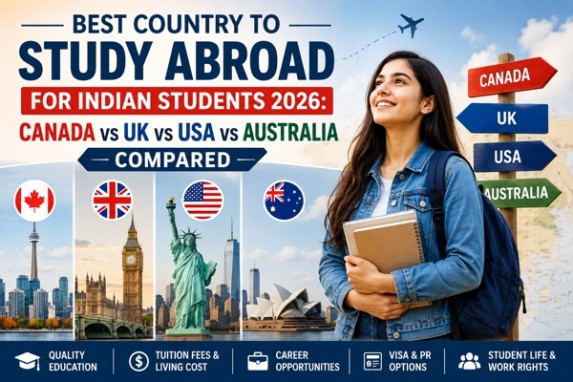
Best Country to Study Abroad for Indian Students 2026: Canada vs UK vs USA vs Australia Compared
Every year, thousands of Ahmedabad students ask us the same question first: "Which country should I even apply to?" Course, city, and university matter — but so does getting an honest, side-by-side look at what Canada, the UK, the USA, and Australia actually cost, how long each visa takes, and what happens after graduation. This guide lays out the current 2026 numbers for all four, so you can shortlist with facts instead of guesswork before you start your student visa application with Volumaax.
Which country is best for Indian students to study abroad in 2026?
There's no universal answer — the right country depends on your course, budget, and what you want to do after graduation. As a general pattern we see across applicants:
- Canada — strong for affordability and a large Indian student community, but proof-of-funds and permit rules have tightened significantly in 2025–2026.
- UK — fast, standardised process and a well-known Graduate Route, but 2026 fee and financial-requirement changes have raised the entry bar.
- USA — the strongest long-term career and research reputation, especially in STEM, but the highest overall cost and a consular interview that carries real refusal risk.
- Australia — solid post-study work rights, particularly for regional study, with costs sitting between the UK and USA once currency conversion is applied.
Volumaax maps your specific academic profile and budget against all four before recommending a shortlist — rather than pushing one country by default.
Canada vs UK vs USA vs Australia: student visa cost comparison 2026
| Country | Visa application fee | Living-cost funds required | Additional government fee |
|---|---|---|---|
| Canada | CAD 150 (study permit) | CAD 22,895 (outside Quebec) + first-year tuition | Provincial Attestation Letter (PAL) mandatory since SDS closure |
| UK | £558 | £1,529/month (London) or £1,171/month (outside London), up to 9 months | Immigration Health Surcharge (IHS), paid per year of stay |
| USA | USD 185 (MRV) + USD 350 (SEVIS I-901) | Full first-year tuition + living costs per I-20 (no fixed national figure) | Health insurance is separate and mandatory at most universities |
| Australia | AUD 2,500 (from July 1, 2026) | AUD 29,710 living costs + tuition + travel | Overseas Student Health Cover (OSHC) for full visa duration |
Figures above are current 2026 government figures at the time of writing. All four governments review these amounts periodically — confirm the live number on the official portal (canada.ca, gov.uk, travel.state.gov, or homeaffairs.gov.au) before transferring funds.
How much bank balance do I need for a student visa in 2026?
This is the single most-asked question we get in Ahmedabad, and the honest answer is: it depends on which country and which city within it. As a quick reference, for a single applicant with no dependants:
- Canada: CAD 22,895 in liquid living-cost funds, on top of proof of first-year tuition payment.
- UK: 28 consecutive days of held funds at £1,529/month if studying in London, or £1,171/month elsewhere, calculated for up to 9 months.
- USA: The exact figure is set by your university on the I-20 and varies by institution and city — there's no single national number, so budget against your specific offer letter.
- Australia: AUD 29,710 for the year, calculated as a "sum of parts" alongside tuition and travel, not as a replacement for them.
Across all four countries, the same mistakes cause refusals: unexplained sudden large deposits, funds that don't match the source-of-income documentation, and showing only one cost bucket (say, living costs) while forgetting tuition or travel. Volumaax reviews your financial documentation before it goes anywhere near an embassy.
Which country has the easiest student visa process for Indians in 2026?
"Easiest" usually means fewest surprises, not fewest documents. Here's how the four compare on process:
- UK — once your CAS, financial evidence, and English test are aligned, the process is largely predictable and decision timelines are among the most consistent of the four.
- Canada — has become more document-intensive since the Student Direct Stream was discontinued; a mandatory Provincial Attestation Letter and detailed letters of explanation are now standard.
- USA — paperwork itself is simple (I-20, SEVIS, DS-160), but the in-person consular interview is subjective and carries genuine refusal risk regardless of how strong the file looks on paper.
- Australia — application processing is fast, but the Genuine Student requirement (which replaced the GTE statement) is scrutinised closely, and weak or generic answers are a common refusal reason.
Post-study work visa comparison: Canada vs UK vs USA vs Australia
| Country | Post-study work option | Typical duration |
|---|---|---|
| Canada | Post-Graduation Work Permit (PGWP) | Up to 3 years, program-dependent; co-op work permit stream removed per IRCC's April 9, 2026 notice |
| UK | Graduate Route | 18 months for most graduates following the 2026 policy changes |
| USA | Optional Practical Training (OPT) | 12 months standard; up to 36 months total for eligible STEM graduates |
| Australia | Temporary Graduate visa (subclass 485) | Varies by qualification level; longer for regional study |
Which country is cheaper to study for Indian students in 2026?
On tuition plus living costs for a comparable master's program, Canada and the UK generally work out less expensive overall than the USA. Australia tends to sit close to the UK once currency conversion is applied. The USA has by far the widest spread — a public state university can come in cheaper than a UK program, while a private US university can cost substantially more than any of the other three. National averages only go so far; the real number depends on your shortlisted university and city, which is why Volumaax builds a cost comparison against your actual offers rather than a generic country average.
How Volumaax helps you choose the right country and secure your student visa
Whichever of these four countries fits your goals, the process from here is the same: university and course selection, a Statement of Purpose that reflects your genuine intent, financial documentation structured the right way for that country's specific rules, and interview preparation where applicable. Volumaax handles all of it end-to-end from Ahmedabad — see our full Student Visa service, or explore country-specific guidance for Canada, the UK, the USA, and New Zealand. If financing is a concern, our Education Loan Services can help structure your funds correctly, and our Visa Interview Preparation service covers the USA and other interview-based routes.
For a deeper look at any single destination, see our detailed guides: UK Student Visa 2026 fee and policy changes, Study in Germany 2026, and Study in Poland 2026.
Not sure which country fits your profile?
Talk to Volumaax for a free, honest comparison based on your course, budget, and career goals.
Frequently Asked Questions
Which country is best for Indian students to study abroad in 2026?
There is no single "best" country — it depends on budget, course, and post-study work goals. Canada and the UK currently offer the fastest, most structured pathways for Indian students; the USA offers the strongest long-term career and research value for students who can meet its higher cost bar; Australia sits in between on cost with strong post-study work rights tied to regional study. Volumaax compares your specific profile against all four before recommending one.
How much bank balance do I need for a student visa in 2026?
As of 2026: Canada requires CAD 22,895 in living-cost funds (outside Quebec) plus first-year tuition; the UK requires 28 days' held funds of £1,529/month if studying in London or £1,171/month outside London (up to 9 months), plus tuition; the USA requires funds covering full first-year tuition and living costs as certified on the I-20, with no single fixed government figure; Australia requires AUD 29,710 in living costs plus tuition and travel. Always confirm current thresholds on the official immigration site before transferring funds.
Which country has the easiest student visa process for Indians in 2026?
The UK's Student visa route is generally considered the most document-standardised and fastest to decision for most Indian applicants once the CAS, financial evidence, and English test are in order. Canada's process has become more document-heavy since the Student Direct Stream was discontinued and Provincial Attestation Letters became mandatory. The USA's F-1 process is straightforward on paperwork but the consular interview carries real refusal risk. Australia's process is fast on paper but the Genuine Student requirement is closely scrutinised.
Which country is cheaper to study for Indian students in 2026?
On tuition plus living costs, Canada and the UK tend to work out less expensive overall than the USA for a comparable master's degree, while Australia sits closer to the UK once currency conversion is applied. The USA has the widest range — a state university can be cheaper than a UK program, while a private US university can cost significantly more. Volumaax builds a real cost comparison against your shortlisted universities rather than relying on national averages.
What are the post-study work visa options after studying in Canada, UK, USA or Australia?
Canada offers the Post-Graduation Work Permit (PGWP), though eligibility has tightened and the co-op work permit stream was removed per IRCC's April 9, 2026 notice. The UK offers the Graduate Route, currently 18 months for most graduates following the 2026 fee and policy changes. The USA offers Optional Practical Training (OPT), 12 months standard and up to 36 months total for eligible STEM graduates. Australia's Temporary Graduate visa (subclass 485) duration depends on qualification level and whether the course was studied regionally.
Can I switch my study abroad country choice after starting the application process?
Yes, but it means restarting documentation for the new country's specific requirements — financial proof formats, English test acceptance, and application portals differ across Canada, UK, USA and Australia. Volumaax recommends finalising your country and university shortlist together with a consultant before paying any non-refundable fees, to avoid duplicate SEVIS, CAS, or PAL costs.
Do I need IELTS for all four countries — Canada, UK, USA and Australia?
Most universities in all four countries accept IELTS, but each also accepts alternatives: the UK accepts its own Secure English Language Test list alongside IELTS; the USA widely accepts TOEFL and Duolingo English Test in addition to IELTS; Canada and Australia both accept PTE Academic as a common alternative. Requirements vary by university and course level, so Volumaax confirms the accepted test list for your specific shortlisted institutions.
How can Volumaax help me choose between Canada, UK, USA and Australia?
Volumaax reviews your academic profile, budget, and career goals, then maps them against current visa rules, processing times, and post-study work options for all four countries before recommending a shortlist. We then handle documentation, financial proof structuring, SOP drafting, and visa interview preparation for whichever country you choose.
Disclaimer: Visa fees, financial thresholds, and post-study work rules change periodically and are set solely by each country's government. This article reflects publicly available 2026 figures at the time of writing and is for general information only. Always verify current requirements on official sources — Canada: canada.ca; UK: gov.uk; USA: travel.state.gov; Australia: homeaffairs.gov.au — before making financial or travel decisions. Volumaax is an independent visa and immigration consultancy and is not affiliated with any of these government bodies.


