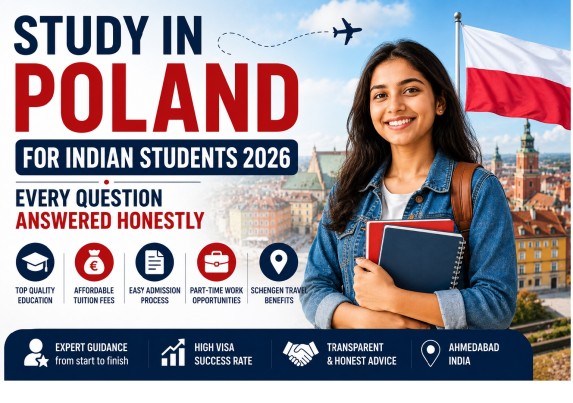
Study in Poland for Indian Students 2026: Every Question Answered Honestly
Jun 26, 2026
Riddhi Mevada
Study in Poland for Indian Students 2026: Every Question Answered | Volumaax
Study in Poland for Indian Students 2026: Every Question Answered Honestly
Written by Riddhi Mevada — Visa & Immigration Content Specialist, Volumaax Ahmedabad
Published: June 25, 2026 | Updated: June 25, 2026 | 12 min read
Introduction: Why Poland Keeps Coming Up in Every Study Abroad Search
If you have been Googling “affordable study abroad for Indian students” or “European university without high fees,” Poland has probably come up more than once. And for good reason.
Poland is a full EU member state with globally ranked universities, 800+ English-taught programs, full Schengen Zone access, and a total annual cost — tuition plus living — of roughly Rs 5 lakh to Rs 13 lakh. Compare that to Rs 35–50 lakh per year in the UK or Rs 25–35 lakh in Canada, and the picture becomes clear.
But what separates a confident decision from second-guessing is having specific, honest answers to the specific questions you actually have. Below are the real questions Indian students search and ask us at Volumaax. Every answer is accurate as of June 2026.
Part 1: Is Poland the Right Choice? The Honest Picture
Is studying in Poland worth it for Indian students in 2026?
Yes — for most profiles. Here is the straightforward case for Poland:
EU-recognised degree: Accredited Polish degrees are recognised across all 27 EU member states and internationally under the Bologna Process
English-medium programs: 800+ fully English-taught programs across engineering, medicine, business, IT, law, and hospitality
Schengen Zone access: With a Polish student visa and Temporary Residence Permit, you can travel freely across 27 Schengen countries — weekend trips to Berlin, Prague, Vienna, or Amsterdam on budget airlines from as low as €15–30
Low living costs: Rs 35,000–Rs 55,000 per month depending on city — significantly lower than Western Europe
Part-time work rights: 20 hours per week during semester, full-time during holidays — earning Rs 30,000–Rs 50,000 monthly
The honest limitation: Poland does not offer an automatic post-study work visa like the UK Graduate Visa or Canada’s PGWP. After graduation you get a 9-month job search permit. If you plan to settle abroad long-term, Canada or the UK offer clearer PR pathways. But if your goal is a quality European degree at the lowest possible cost — Poland is difficult to beat.
Is Poland safe for Indian students?
Yes — Poland is one of the safest countries in Europe with low crime rates and student-friendly cities. There are over 3,000 Indian students currently studying across Poland, with established Indian communities particularly in Warsaw, Krakow, Wroclaw, Lublin, and Lodz. Indian groceries, restaurants, and WhatsApp communities of Indian students make the transition significantly easier than many students expect.
How does Poland compare to Germany and the UK for Indian students?
Factor
Poland
Germany
UK
Annual tuition
Rs 1.8–6.5 lakh
Rs 0–1 lakh (public) / Rs 8–15 lakh (private)
Rs 20–40 lakh
Living cost/month
Rs 35,000–55,000
Rs 60,000–90,000
Rs 1,00,000–1,50,000
IELTS required
6.0 (MOI waiver possible)
Not required for German programs
5.5–7.0 (no full MOI waiver)
Schengen access
Yes — full 27 countries
Yes — full 27 countries
No — UK is not Schengen
Post-study work
9-month job search permit
18 months job search permit
2 years (Graduate Visa)
Path to PR
Possible via employment
After 5 years residence
5 years on Skilled Worker Visa
English program availability
800+ programs
Limited at public universities
Extensive
Part 2: Fees & Costs — Exact Figures
How much does it cost to study in Poland for Indian students in rupees?
Here is a realistic, city-by-city breakdown for 2026:
Total annual cost estimate: Rs 5 lakh to Rs 13 lakh (tuition + living combined). Compare this to Rs 35–50 lakh in the UK or Rs 25–35 lakh in Canada.
How much bank balance is required for a Poland student visa from India?
This is the most searched question about the Poland visa — and most guides give vague answers. Here is the specific picture:
The Polish embassy does not publish a fixed minimum balance on their official website. However, based on immigration guidelines and practical experience:
You should demonstrate funds covering approximately PLN 776 per month (around Rs 16,000 per month at 2026 exchange rates) for living expenses
Plus accommodation costs and a return flight ticket
Safe amount to show: Rs 6 lakh to Rs 10 lakh in savings, held for at least 3 to 6 months in your or your sponsor’s bank account
Indian community sources and experienced consultants recommend showing closer to Rs 8–10 lakh to be comfortably above any informal threshold
The money should show consistent savings history — not a recent lump-sum deposit, which raises questions
If parents are sponsoring you, include their income proof, ITR (Income Tax Returns) for 2 years, and a signed sponsor declaration letter along with their bank statements.
Are there scholarships for Indian students in Poland?
Yes — several genuine ones:
NAWA Scholarship (Polish National Agency for Academic Exchange): Government-funded scholarship for international students. Covers tuition and a monthly stipend. Competitive — apply early at nawa.gov.pl
Erasmus+ Scholarships: If your Indian university has a bilateral agreement with a Polish university, you may qualify for an Erasmus exchange grant
University Merit Scholarships: Most major Polish universities offer 10%–50% tuition waivers based on academic performance. Apply directly in your admission application
Early Bird Discounts: Many private universities offer fee reductions for students who confirm admission before a certain date — ask explicitly when applying
Part 3: IELTS & Language Requirements
Is IELTS required for a Poland student visa from India?
This has two parts — and most guides confuse them:
For the visa itself: The Polish embassy does NOT mandate IELTS for the student visa. You do not need an IELTS certificate to submit your visa application.
For university admission: Most Polish universities require proof of English language proficiency for English-taught programs. The most common requirements:
IELTS Academic: 6.0 overall (some accept 5.5)
TOEFL iBT: 72–80 minimum
PTE Academic: 50–55
MOI Certificate: Many universities accept a Medium of Instruction certificate from your 10th/12th school or college, confirming English was your language of education — this is the most common IELTS alternative for Indian students
Get your MOI certificate from your school or college early — it saves the cost and preparation time of an IELTS test. However, always confirm with your specific university and program before assuming MOI is accepted.
What if my IELTS score is below 6.0? Can I still study in Poland?
Yes — several options:
Submit an MOI certificate instead (if your school was English medium)
Enrol in a pre-sessional English program offered by many Polish universities before your main course begins — this satisfies the language entry requirement
Apply to programs with lower English requirements (some foundations and certificate programs accept 5.0–5.5)
Apply to programs in Polish — a few universities offer full scholarships for students who study in Polish (including language preparation)
Part 4: Top Universities & Programs
What are the top universities in Poland for Indian students?
University of Warsaw (UW): QS Rank 271 in 2026. Poland’s most prestigious public university. Strong in law, economics, humanities, and sciences.
Jagiellonian University, Krakow: QS Rank 303. One of the oldest universities in Europe (founded 1364). Excellent for medicine, law, and sciences.
Warsaw University of Technology (WUT): Top-ranked technical university. Strong in engineering, computer science, and architecture. Highly regarded by Indian employers.
Wroclaw University of Science and Technology: Engineering, IT, and environmental sciences. Strong industry connections.
Kozminski University, Warsaw: Top-ranked private business school in Central Europe. Excellent MBA and management programs. AACSB and EQUIS accredited.
Medical University of Warsaw, Lublin, Wroclaw, Lodz, Poznan, and Krakow: Accredited MBBS programs. Popular with Indian medical students.
Lodz University of Technology: Good for engineering and textile management. Lower cost than Warsaw.
Is MBBS in Poland recognised in India?
This is the question every Indian medical student asks — and the answer requires careful reading:
International recognition: MBBS from accredited Polish medical universities (called MD in Poland, following a 6-year integrated program) is recognised by the World Health Organization (WHO), the European Commission, and the Medical Council in most countries.
Recognition in India: To practice medicine in India after studying abroad, you must:
Graduate from a medical university recognised by the National Medical Commission (NMC) of India
Pass the FMGE (Foreign Medical Graduate Examination) — a screening test conducted by NMC
Complete compulsory internship in India
Most major Polish medical universities (University of Warsaw Medical Faculty, Jagiellonian Medical College, Medical Universities of Lublin, Wroclaw, Poznan, Lodz) are on the NMC-recognised list. Always verify your specific university on the NMC website before paying any admission fee. An unrecognised university means you cannot practice in India even after graduating.
What are the most popular programs for Indian students in Poland?
MBBS / Medicine (6-year program, EU-recognised)
Computer Science and IT
Engineering (Civil, Mechanical, Electrical)
Business Administration and MBA
Architecture
Nursing and Healthcare
Finance and Accounting
Hospitality and Tourism Management
Both October (main) and February intakes are available. October is the primary intake — apply by June/July for October enrollment.
Part 5: Poland Student Visa Process
What type of visa do Indian students need to study in Poland?
Indian students need a Type D National Visa (Long-Stay Visa) for courses longer than 90 days — which covers all degree programs. For short courses or language programs up to 90 days, a Type C Schengen Visa suffices.
After arriving in Poland, you must apply for a Temporary Residence Card (Karta Pobytu) — this is your legal residence and identity document for the duration of your studies. Apply for it within your first month of arrival at the local provincial office (Urzad Wojewodzki).
What is the step-by-step Poland student visa process for Indian students?
Choose your course and university — confirm English-taught programs and NMC recognition if applying for medicine
Apply to the university and receive your offer letter / admission letter
Pay the admission fee or first semester tuition — payment receipt is required for the visa
Gather all visa documents (see list below)
Book your appointment at the Polish Embassy in New Delhi or the Polish Consulate in Mumbai (currently the two locations in India)
Attend the appointment and submit your application
Wait for visa decision — typically 2 to 4 weeks
Travel to Poland and register your address within a few days of arrival
Apply for Temporary Residence Card (Karta Pobytu) within your first month
What documents are required for a Poland student visa from India?
Completed Type D visa application form
Valid passport (minimum 3 months validity beyond your intended stay)
University admission letter or offer letter
Proof of tuition fee payment (at least first semester)
Academic certificates — 10th, 12th, and undergraduate transcripts
IELTS certificate or MOI (Medium of Instruction) certificate
Bank statements (last 3–6 months) showing Rs 6–10 lakh in savings
Sponsor’s income proof and ITR (if parents are sponsoring)
Sponsor declaration letter
Health insurance certificate (mandatory for the visa — minimum coverage €30,000)
Accommodation proof in Poland (university hostel booking or rental agreement)
Return flight ticket booking
2 passport-size photographs
Visa fee payment: approximately €80 (Rs 7,000–Rs 8,000 at current rates) plus VFS service charges
Is there an interview for the Poland student visa?
Not mandatory for every applicant. However, the Polish Embassy or Consulate reserves the right to call any student for an interview to verify study plans and financial documents. In practice, interviews are more likely if:
Your application has incomplete or inconsistent documents
Your bank balance was recently inflated (sudden large deposits)
The officer needs to verify your connection to the chosen university or program
If called for an interview, prepare to answer: Why Poland? Why this university? Who is funding you? What are your plans after graduation? Have clear, honest answers and matching documents.
How long does the Poland student visa process take from India?
Typically 2 to 4 weeks from the date of your appointment. During peak season (June to September, when October intake applications are processed), wait times can be slightly longer. Book your embassy appointment as early as possible — slots fill up. Apply at least 8 to 10 weeks before your intended travel date.
Part 6: Working & Life in Poland
Can Indian students work while studying in Poland?
Yes — and this is one of Poland’s strongest practical advantages. Indian students on a Type D student visa and Temporary Residence Card can work:
Up to 20 hours per week during the academic semester — no separate work permit required
Full-time during official university holidays (summer, Christmas, Easter)
How much can you earn? Poland’s minimum wage in 2026 is PLN 28–30 per hour. Working 20 hours per week generates approximately PLN 1,500–2,500 per month (Rs 30,000–Rs 50,000). This is enough to cover most or all monthly living expenses — a significant difference from studying in the UK or Australia where living costs quickly outpace part-time income.
Popular sectors for international students: hospitality, retail, customer service, tech support (especially in Warsaw’s growing tech sector), and on-campus university jobs.
Can Indian students travel to other European countries from Poland?
Yes — and this is one of the biggest advantages Poland has over non-Schengen study destinations like Cyprus or the UK. Poland is a full Schengen member. With a valid Polish Temporary Residence Card, you can:
Travel visa-free to all 27 Schengen countries including Germany, France, Italy, Spain, Netherlands, Austria, Czech Republic, Switzerland, and more
Budget airlines Ryanair and Wizz Air operate from Warsaw, Krakow, and Wroclaw with fares from €15–30 for intra-European flights
Weekend trips to Berlin (3 hours by train), Prague (6 hours), or Vienna (8 hours) are common
This Schengen access adds enormous lifestyle and networking value to a Polish degree — something students only fully appreciate after they arrive.
Can I stay in Poland and work after graduation?
Yes — but unlike the UK or Canada, there is no automatic multi-year post-study work visa. Here is what actually happens:
After graduating, you can apply for a 9-month Temporary Residence Permit for job searching
During this 9 months, you can legally work full-time while looking for a job
If you find employment, your employer applies for a work permit on your behalf and you extend your residence
After 5 years of continuous legal residence in Poland, you can apply for permanent residency
IT, engineering, finance, and business graduates have the strongest job prospects in Poland, particularly in Warsaw (a growing European tech hub) and Krakow (home to major multinational shared service centres)
Part 7: Common Visa Rejection Reasons & How to Avoid Them
What are the most common reasons Poland student visa gets rejected?
Insufficient or inconsistent financial proof: Recent large deposits that do not match your income history raise immediate red flags. Show 3–6 months of consistent savings, not a last-minute transfer
Incomplete documents: Missing health insurance, missing accommodation proof, or missing MOI/IELTS certificate
No convincing study purpose: If your SOP (Statement of Purpose) does not explain clearly why Poland, why this university, and why this course — the officer’s confidence in your genuine study intent drops
Questionable intent to return to India: No employment history, no family ties, no clear plan after graduation — visa officers assess whether you will return
University not recognised or poorly ranked: Applying to obscure private institutions without checking their standing raises red flags. Always apply to universities on established ranking lists
Gap in academics not explained: If you have a gap year or gap after graduation, your SOP must address it clearly. Unexplained gaps reduce credibility
Frequently Asked Questions
Q: Is studying in Poland worth it for Indian students in 2026?
Yes — for most profiles. EU-recognised degree, English-medium education, Schengen Zone travel, and part-time work rights at a total annual cost of Rs 5–13 lakh. One-quarter the cost of the UK with comparable European education quality.
Q: How much bank balance is needed for a Poland student visa from India?
Rs 6 lakh to Rs 10 lakh held for at least 3 to 6 months in your or your sponsor’s account. This covers the informal assessment for living costs (PLN 776 per month) plus accommodation and return flight. Show consistent savings history — not a recent lump-sum deposit.
Q: Is IELTS required for Poland student visa?
Not for the visa itself. But most Polish universities require IELTS 6.0 for admission to English-taught programs. Many universities accept an MOI (Medium of Instruction) certificate from your school or college as an alternative. Confirm with your specific university.
Q: Is MBBS in Poland recognised in India?
Most major Polish medical universities are on the NMC (National Medical Commission) recognised list. However, you must pass the FMGE (Foreign Medical Graduate Examination) to practice medicine in India. Always verify your specific university on the NMC website before applying.
Q: Can Indian students travel to Europe from Poland?
Yes. Poland is in the Schengen Zone. With a valid Polish Temporary Residence Card, you can travel to all 27 Schengen countries visa-free. This is a major advantage over Cyprus, which is EU but not Schengen.
Q: How much can Indian students earn working part-time in Poland?
PLN 1,500–2,500 per month (Rs 30,000–Rs 50,000) working 20 hours per week at the minimum wage of PLN 28–30 per hour. Enough to cover most monthly living expenses.
Q: What is the Poland student visa fee from India?
Approximately €80 (Rs 7,000–8,000 at current rates) plus VFS Global service charges. Total cost including VFS fees and biometrics is approximately Rs 10,000–Rs 15,000.
Q: Can I stay in Poland after graduation?
Yes — a 9-month job search residence permit allows you to remain and work full-time while finding employment. If you find a job, your employer sponsors your work permit. After 5 years of legal residence, permanent residency is possible.
Q: What intakes are available at Polish universities?
October (main intake — for the academic year starting October) and February (secondary intake). Apply 3–4 months in advance. For October intake, apply by June/July.
Q: Is health insurance mandatory for a Poland student visa?
Yes. You must show proof of health insurance with minimum coverage of €30,000 for the visa application. Many Polish universities offer affordable student insurance plans from around €100–200 per year once you enrol.
Planning to study in Poland from Ahmedabad? Volumaax provides complete support — university shortlisting, SOP guidance, document preparation, visa filing, and pre-departure support. Visit www.volumaax.com or call +91 96872 95519.
Disclaimer: Polish immigration rules, embassy requirements, and university fees are subject to change. This blog reflects information verified as of June 2026. Always confirm current requirements directly with your chosen university and the Polish Embassy in New Delhi before applying. Source: Polish Ministry of Interior and Administration and NAWA — Polish National Agency for Academic Exchange


 Sep 16, 2026

 Riddhi Mevada


