

 Sep 16, 2026

 Jun 18, 2026
 Riddhi Mevada
One of the most common questions we get from professionals in Ahmedabad is: “What CRS score do I actually need to get an Invitation to Apply (ITA) for Canada PR?”
It is a fair question — and the honest answer is that it depends on which stream you are applying through and when your draw happens. But the more important point is this: if you are a skilled professional between 25 and 40, there is a very real chance that Canada PR is within reach, and the Express Entry system is designed exactly for people like you.
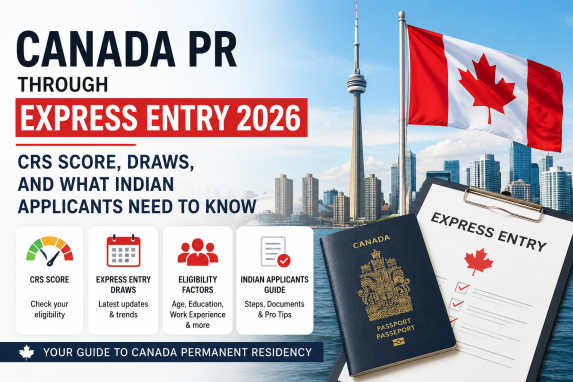
Canada received over 400,000 new permanent residents in 2025 and has set ambitious targets for 2026–2028. The demand for skilled workers from India — in healthcare, technology, engineering, finance, and trades — has never been higher. Express Entry is the fastest federal pathway, and it is where we will focus in this guide.
In this blog, we break down how Express Entry works, how your CRS score is calculated, what scores are being accepted in 2026, and what happens after you receive an ITA. We have guided applicants through FSW, CEC, and PNP streams — and we want to give you the clearest possible picture before you take your next step.
Express Entry is Canada’s online immigration management system for skilled workers. It manages applications under three federal programs:
Once you submit an Express Entry profile, you are placed in a pool of candidates. IRCC (Immigration, Refugees and Citizenship Canada) holds regular draws — selecting the highest-ranked candidates and issuing them an Invitation to Apply (ITA) for permanent residence. The ranking is done through a points-based system called the Comprehensive Ranking System — or CRS score.
Your CRS score is made up of four main components. Understanding each one helps you know where you stand — and where you can improve.
If your partner accompanies you, their education, language scores, and Canadian work experience also contribute to your total CRS score.
Combinations of strong factors earn bonus points — for example, a high language score paired with a Canadian degree, or foreign work experience combined with strong language results.
The maximum possible CRS score is 1,200 points. In practice, most competitive Indian applicants without a PNP score between 440 and 540 depending on their profile. A PNP nomination pushes that to 1,040–1,140, making an ITA virtually certain.
This is where many applicants get confused — because the answer changes with every draw.
In 2026, IRCC has moved decisively toward category-based draws rather than broad all-program draws. What this means in practice:
Latest Draw (May 28, 2026): Draw #418 — French Language Proficiency, 4,500 ITAs issued, CRS cut-off: 409. As of May 2026, IRCC has issued 79,841 ITAs across 30 draws in 2026. Source: IRCC Official Express Entry
The key takeaway: if your CRS score is below 470 and you do not have a PNP nomination, a general draw may not reach you immediately. But a provincial nomination or category-specific eligibility changes the picture entirely — and this is where getting a proper profile assessment matters.
The Provincial Nominee Program (PNP) is the single most powerful tool available to Express Entry applicants who are not already in Canada.
Each Canadian province has its own immigration streams targeting specific skills and occupations. If a province nominates you, 600 points are added to your CRS score. Since most PNP draws set cut-offs at 700–750 (which includes the 600-point bonus), your base CRS score only needs to be around 100–150 to receive an ITA after nomination.
Most PNP streams require a valid Express Entry profile first. Applying to provincial streams while your Express Entry profile is active — rather than waiting passively for a draw — is one of the most effective strategies for Indian applicants in 2026. For a complete overview of all Canada PR pathways, visit our dedicated page.
Receiving an Invitation to Apply is the milestone most people aim for — but the clock starts ticking the moment it arrives.
If you or your child is currently studying or planning to study in Canada, the path from a study permit to PR through PGWP and Canadian Experience Class is one of the most reliable routes available. See our Canada student visa page for details on how the study permit process works and how it connects to your long-term PR goals. If you are already working in Canada, our work permit to PR transition guide covers that pathway in detail.
No — a job offer is not mandatory for FSW or CEC. However, a valid Canadian job offer adds 50–200 points to your CRS score depending on the type. For most Indian applicants, strong education, language scores, and age are sufficient to build a competitive profile without one.
Yes — the Federal Skilled Worker (FSW) stream is specifically designed for applicants outside Canada. You need at least one year of continuous full-time skilled work experience in the past 10 years, a language score of at least CLB 7 in all four skills, and a valid ECA for your degree. Many of our Ahmedabad clients have received ITAs through FSW without ever having lived in Canada.
A rough timeline: 4–8 weeks to prepare and submit your Express Entry profile, then a wait in the pool (from a few weeks to over a year depending on your score), then 6 months of processing after receiving an ITA. A straightforward application can take 12–18 months total from profile creation to PR status.
Yes — create your profile. A score of 430–460 is competitive for certain category-based draws and PNP nominations, and will improve if you raise your language scores or gain additional qualifications. Having an active profile in the pool is essential because you cannot receive an ITA if you are not in the pool.
That is completely reasonable. You can apply for a visitor visa independently while your PR process runs in parallel. For details on visiting Canada, see our Canada Visitor Visa guide — it covers TRV, Super Visa, and what documents you need to plan a visit.
FSW (Federal Skilled Worker) is for applicants outside Canada with foreign work experience. CEC (Canadian Experience Class) is for those already working inside Canada. PNP (Provincial Nominee Program) is a province-specific nomination that adds 600 CRS points and works in combination with either FSW or CEC. The right stream depends entirely on your current profile and situation.
Yes. IELTS scores are valid for two years from the test date. If your scores expire while your profile is in the pool, your profile becomes invalid and must be updated with new scores. Plan your IELTS test timing carefully relative to when you expect to receive an ITA.
The most useful thing you can do right now is not search for the latest CRS cut-off score. It is to understand where your profile actually stands.
At Volumaax, we have guided applicants from Ahmedabad and across Gujarat through the FSW, CEC, and PNP streams. We look at your specific age, education, language scores, work experience, and occupation code — and we tell you honestly which pathway makes the most sense, what your CRS score is likely to be, and what steps would improve it.
CRS scores change with every draw, and the best strategy is one built around your profile — not a generic guide. That is what our free consultation is for.
For a complete overview of all Canada immigration options, visit our Canada immigration page. For details specifically on the PR pathways available in Canada, visit our Canada PR Visa page. For PR Visa assistance from our team, reach out directly.
Book a free consultation at www.volumaax.com or call us at +91 96872 95519.
Disclaimer: Immigration rules, CRS cut-off scores, and draw patterns change regularly. This blog is for informational purposes only and reflects data available as of June 2026. Always consult a qualified immigration professional for advice specific to your situation. Source: Immigration, Refugees and Citizenship Canada (IRCC)


