

 Sep 16, 2026

 Apr 27, 2026
 Rylie
Rylie
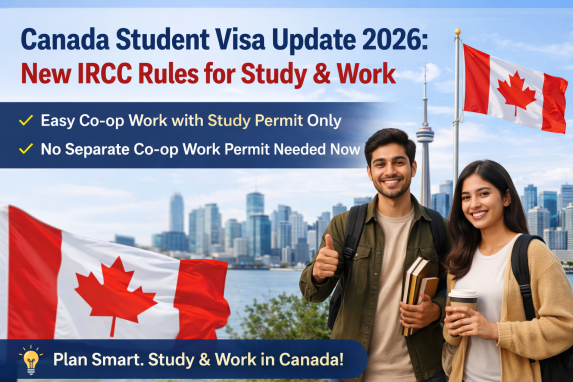
Effective April 1, 2026, Immigration, Refugees and Citizenship Canada (IRCC) officially removed the requirement for a separate co-op work permit for eligible post-secondary international students. IRCC confirmed this in a program delivery update on April 17, 2026.
In plain terms: if you are an international student in Canada enrolled in a program with mandatory co-op placements, internships, or practicums, your study permit now covers that work. You no longer need to apply for, wait for, or pay for a second permit.
This single change eliminates approximately 120,000 permit applications per year — reducing processing delays, cutting documentation costs, and allowing students to begin placements faster. Source: IRCC Official Notice, April 9, 2026
→ See also: Canada student visa overview at Volumaax
The old system created a situation that made no practical sense. International students enrolled in mandatory co-op programs — where the work placement is literally required to complete their degree — still had to apply for a separate government permit to do that work. This created three real problems:
Canada is also competing internationally for international students. Australia tightened work-hour limits for foreign students in 2026, and the United States still requires separate Curricular Practical Training (CPT) authorization for most internships. By removing this requirement, Canada is making its student experience genuinely more practical while maintaining regulatory oversight through institution-level approval of placements.
This is the section most blogs get wrong or skip entirely. The co-op permit removal is not automatic for every international student in Canada. You must meet all of the following conditions:
If your placement is in healthcare, education, or agricultural settings, IRCC advises students to ensure their study permit has no restrictions on working in those areas, and to confirm whether an immigration medical examination is required.
| Factor | Before April 1, 2026 | After April 1, 2026 |
|---|---|---|
| Permits required | Study permit + co-op work permit (two documents) | Study permit only (one document) |
| Application required | Yes — separate co-op permit application | No additional application needed |
| Processing wait | 4+ months for co-op permit | None for placement work authorization |
| Cost | Co-op permit fee + processing costs | No additional cost |
| Placement start | Could not start until co-op permit approved | Can start once institution confirms placement is mandatory |
| Applies to | Post-secondary DLI students | Post-secondary DLI students (secondary school not covered) |
| Work hour limit change | — | No change — administrative only |
If you submitted a co-op work permit application before April 1, 2026 and it is still pending, you do not need to take any action. IRCC confirmed it will automatically withdraw all eligible pending co-op work permit applications and notify affected students directly.
If you prefer to withdraw your own application rather than wait for IRCC to do it, you can do so through your IRCC online account. Any fees paid for applications withdrawn by IRCC are expected to be refunded.
If you currently hold a valid co-op work permit that was approved before the change, you also do not need to take any action — your existing permit remains valid for its duration.
Several important points are being misunderstood or exaggerated online. This is what the April 2026 change does not do:
Yes — and this is a practical detail most blogs do not mention. Even though you no longer need a co-op work permit, you will still need a Social Insurance Number (SIN) to receive payment from your employer. A SIN is required for any paid work in Canada.
Apply for your SIN at a Service Canada office once your study permit is issued. Your SIN letter shows your work authorization conditions, and your employer will verify both your study permit and SIN before you begin your placement.
This is the part that Indian students planning long-term in Canada should understand clearly.
Canadian work experience gained during a co-op placement on a study permit counts toward PGWP eligibility and contributes to your CRS score for Express Entry — provided the work is in a NOC TEER 0, 1, 2, or 3 skilled occupation. The removal of the co-op permit requirement means:
The study-to-co-op-to-PGWP-to-CEC Express Entry pathway remains one of the most reliable routes to Canada PR for Indian students. The April 2026 change makes the co-op component of that pathway smoother — not fundamentally different, but meaningfully faster.
→ See also: Canada PR pathways explained | Canada work permit to PR transition
The co-op permit removal is confirmed and in effect. But IRCC has also announced additional proposed changes that are currently in the consultation phase with provinces, territories, and educational institutions. These proposals — not yet law — would:
No implementation timelines have been announced for any of these additional proposals. We will update this blog when dates are confirmed. The only confirmed change as of July 2026 is the co-op work permit removal from April 1, 2026.
If you are planning to apply for a Canada study permit for the September 2026 or January 2027 intake, here is what this update means for your planning:
→ See also: Student visa assistance at Volumaax | Canada PR visa assistance
No. As of April 1, 2026, eligible post-secondary international students no longer need a separate co-op work permit for mandatory work placements. A valid study permit with on-campus work authorization now covers co-ops, internships, and practicums — provided the placement is a program requirement and makes up 50% or less of total program hours.
You must: (1) be enrolled at a post-secondary DLI, (2) have on-campus work conditions on your study permit, (3) have a mandatory placement confirmed by your institution in writing, (4) ensure the placement is 50% or less of your total program hours, and (5) hold a valid study permit or have applied to extend it before expiry. Secondary school students are not covered.
Nothing. IRCC will automatically withdraw all eligible pending co-op work permit applications and notify you. You can also withdraw your application yourself through your IRCC online account if you prefer not to wait.
No. This is an administrative change only. Off-campus work remains at 24 hours per week during term (pilot extended through December 2027) and full-time during scheduled academic breaks. The number of hours is unchanged.
Yes. Canadian work experience in a TEER 0/1/2/3 occupation gained during a co-op placement on a study permit counts toward PGWP eligibility and contributes to your CRS score through the Canadian Experience Class (CEC) stream.
IRCC has proposed extending work authorization to students awaiting study permit renewals and to graduates awaiting PGWP decisions, plus removing the study permit requirement for foreign apprentices. As of July 2026, these remain under consultation — no implementation dates have been confirmed.
Yes. The co-op permit removal does not change the SIN requirement. You still need a SIN to receive payment from your employer. Apply at a Service Canada office once your study permit is issued.
The change applies, but with additional checks. Placements in healthcare, education, or agricultural settings require you to confirm your study permit has no restrictions on working in those areas. An immigration medical examination may also be required. Confirm with your institution and check your study permit conditions carefully before starting.
Planning to study in Canada in 2026? Volumaax in Ahmedabad helps you select the right program, prepare your study permit application, and plan your path from co-op experience to PGWP to Canada PR. Visit www.volumaax.com or call +91 96872 95519.
→ Also read: Canada Immigration 2026: 20 Questions Answered
→ Explore: Canada Student Visa at Volumaax
→ Explore: Canada PR Pathway at Volumaax
→ Explore: Student Visa Assistance at Volumaax
Disclaimer: This blog reflects IRCC policy confirmed as of July 2026. Immigration rules change regularly. Always verify current requirements directly at canada.ca or consult a qualified immigration professional before making decisions.


